

When it’s time to harvest corn and see the year’s efforts add up, harvest preparation is everything.
A preharvest corn head checklist can help set you up for success.
We know university research indicates that up to sixty percent of yield loss at harvest occurs at the corn head, making equipment preharvest prep crucial. Just two kernels of corn per square foot or one ¾-pound ear in 1/100 acre is equal to one bushel per acre loss. Furthermore, issues like volunteer corn can add to next season’s headaches.
“But it’s through the individual row units — component-by-component — where that loss actually occurs,” says Fenton, Iowa, farmer and Dragotec Vice President of Sales and Marketing Dustin Bollig.
“The devil is in the details,” Bollig says. “Taking time to thoughtfully examine even the smallest parts of your corn head before harvest can significantly minimize overall loss and deliver greater harvest success.”
He suggests the following preharvest checklist as a guide for reducing corn head yield loss and untimely equipment breakdowns.
Snout divider uniformity
Looking down the length of the corn head from the side, snout tips should all be level with one other. Proper alignment helps to prevent header loss, smoothly feed lodged stalks into the combine and reduce the risk of snouts gouging into the ground.
“You want uniformity across the head for accurate header height function and position, this is especially important when harvesting down corn,” says Bollig.
Deck plate wear and calibration
Producers with hydraulic deck plates should look for extra wear in linkage at every one of the many pivot points, Bollig says. Calibration is also an essential preharvest step for hydraulic plate operators.
“It’s crucial to measure and recalibrate the gap in each row for uniformity. Even just 1/8th-inch difference can result in yield loss, and a 1/4” to 1/2″ gap difference is not uncommon today, especially with many acres of wear,” he notes. Inspecting the physical alignment, clearing out any debris and cycling plates through their full range of motion can help growers avoid costly, timely breakdowns mid-harvest.
The Automatic Self-Adjusting Deck Plates on every Drago corn head adjust automatically to stalk widths, row by individual row, and eliminate the worry of proper gap spacing during harvest. And, due to purely mechanical engineering, Drago corn head operators can also avoid the risk of electrical or hydraulic failure causing unwanted delays and downtime.
Knife roller risks
“Pay extra attention to wear within the first 1-3 inches of your knife rollers”, Bollig notes. Despite their overall length, he says that’s where most corn head brands process stalks, compared to Drago’s design that allows stalk processing to move back their full length into the corn head.
“If knife rollers are not pulling plants down as they should, you get more “stripping” vs the pulling down action, delivering more plant material into the combine and yield loss out the back.”
Drago knife rollers also have a smaller diameter and move at a lower velocity tip speed, decreasing the risk of yield loss due to ear bounce and butt shelling. Drago builds in bracket supports to keep knife rollers from spreading and breaking while capturing every kernel possible.
Drive chain tension
Growers should also inspect drive chains and tensions. Bollig recommends removing chains and laying them on a table – moving links in and out to see movement to check wear on roller pins to avoid in-season breakage. “If you’re near the end on tension adjustments, consider replacing them,” Bollig says. “They will break when you need them most.”
Gear-driven drives, such as those found on Drago corn head, last through the life of the head. The Drago GT features the first chainless design, including the auger drive, that’s standard on all row configurations.
This simple inline design, called Endura Drive™, transfers power directly through each row unit for greater efficiency and durability, eliminating two gears per row compared to competitor corn head brands.
Gathering chain longevity
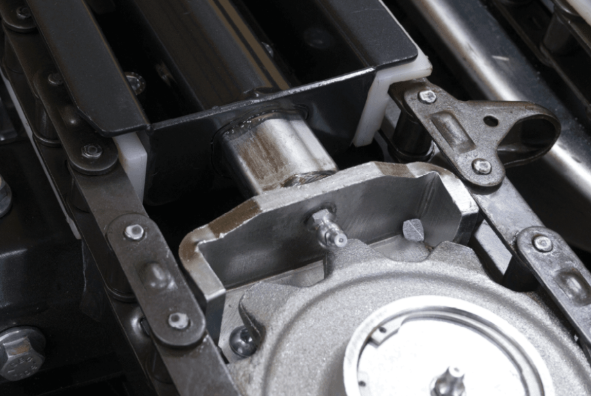
Like drive chains, inspect this critical component for wear at the pins and readjust for proper tension. Loose chains will accelerate wear and, eventually, throw off their sprockets. A common culprit of loose chains are open spring tensioner designs that allow dirt and debris to build up on the spring, decreasing the chain tension. Heads that have this design should be blown off before the season starts and multiple times during the season to prevent loose chains and increase chain life.
Because Drago gathering chains are kept taut by a seize-free tensioner and ride on larger sprockets than others, which reduces chain stress, they consequently last longer. Metallurgical comparisons also show Drago gathering chain pins to be the hardest in the industry, with the hard chrome coating itself proving 20%-40% thicker than other brands.
Have the knowledge before you need it
A preharvest corn head checklist won’t cover every potential harvest hurdle. That’s why Drago offers Drago Club. All Drago owners can access maintenance videos, operator’s manuals and more, whether it’s troubleshooting a repair or getting an annual refresh of optimizing each yield-saving feature on their corn head.
While it may seem obvious, taking the proper steps to ensure your corn head is ready to harvest corn as efficiently and effectively as possible can make all the difference in your bottom line.
*Hanna, H. Mark, “Profitable Corn Harvesting” (2008). Agriculture and Environment Extension Publications. 203. https://lib.dr.iastate.edu/extension_ag_pubs/203