

Case and Deere try to catch up with their own automatic deck plates but can’t top Drago engineering.
For more than 25 years, the Automatic Self-Adjusting Deck Plates on every Drago corn head have helped farmers capture more harvestable yield than competitors’ hydraulic plates. Now, as others begin to acknowledge the importance of this technology and attempt similar engineering, Drago deck plates remain a leader in the field for minimizing gaps and maximizing ROI.
“We’ve proven automatic deck plates make a real difference at harvest, and after decades of Case IH and John Deere sticking with manual, hydraulic plates, it’s rewarding to finally see the rest of the industry catch on,” says Denny Bollig, farmer and president of Dragotec USA. “But they still missed the mark. Knowing a corn head’s deck plates need to adjust is one thing – building one that actually keeps up with every stalk, on every row, is a different challenge altogether. That’s exactly the kind of engineering our manufacturer, Olimac, has spent decades proving out in the field.”
Continuous deck plate adjustments are essential
With up to 60% of yield loss occurring at the head, according to ISU research, continuous adjustments to match stalk variability are crucial. Drago deck plates will continue to capture more yield than new competitor automatic offerings because Drago plates independently, mechanically adjust on every row to continuously match stalk width, regardless of size, the moment stalks enter the corn head. Deck plates on all other heads still rely on hydraulics to adjust them equally across multiple rows.
Indiana corn grower Ryan Kohlhagen says:
“The Drago automatic deck plates work beautifully in our soil type, because the stalks and ears vary in size. An operator going through the field could not make adjustments that fast. It totally made sense for us and our operation to capture that corn.”
Plus, while modern hybrids continue to evolve, research shows stalk width variability rising right alongside higher-yielding corn.
An Iowa State University study found that as little as a 1/8-inch gap between the deck plate and stalk can cause 1–4 bushels of yield loss per acre. Multi-year Drago harvest research that measured deck plate movement caused by variable stalk size demonstrated deck plates made 5,390 adjustments of 1/8”, 1,582 adjustments of 1/4”, and 196 adjustments of 1/2” or more per acre.
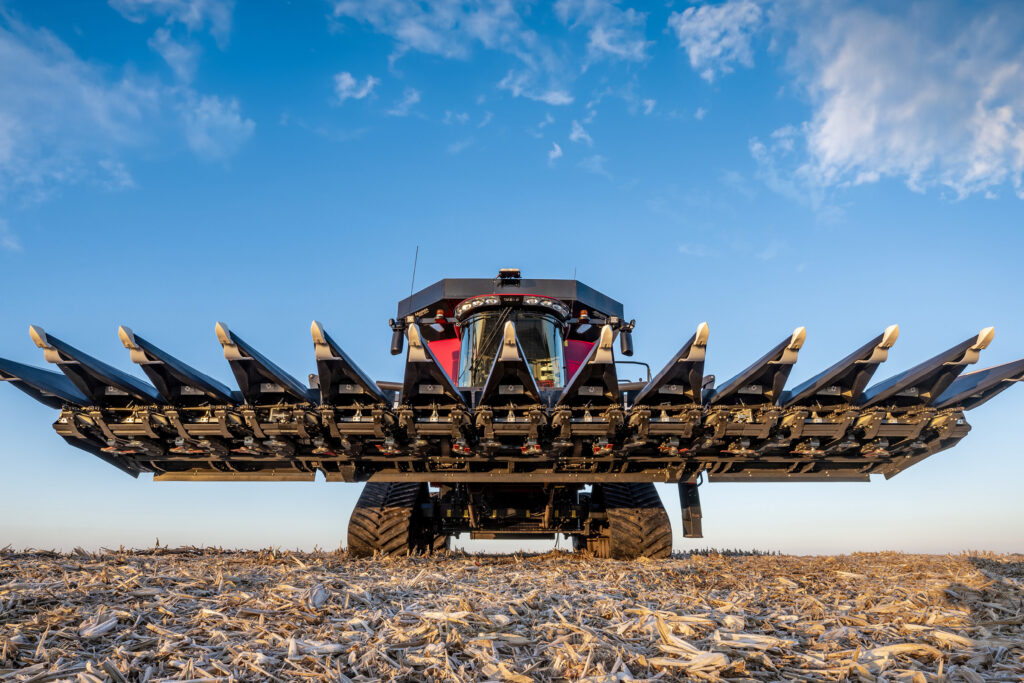
Automatic adjustments beat Case
In a specific breakdown of competitor features, it’s easy to see why Drago’s self-adjusting deck plates are still superior.
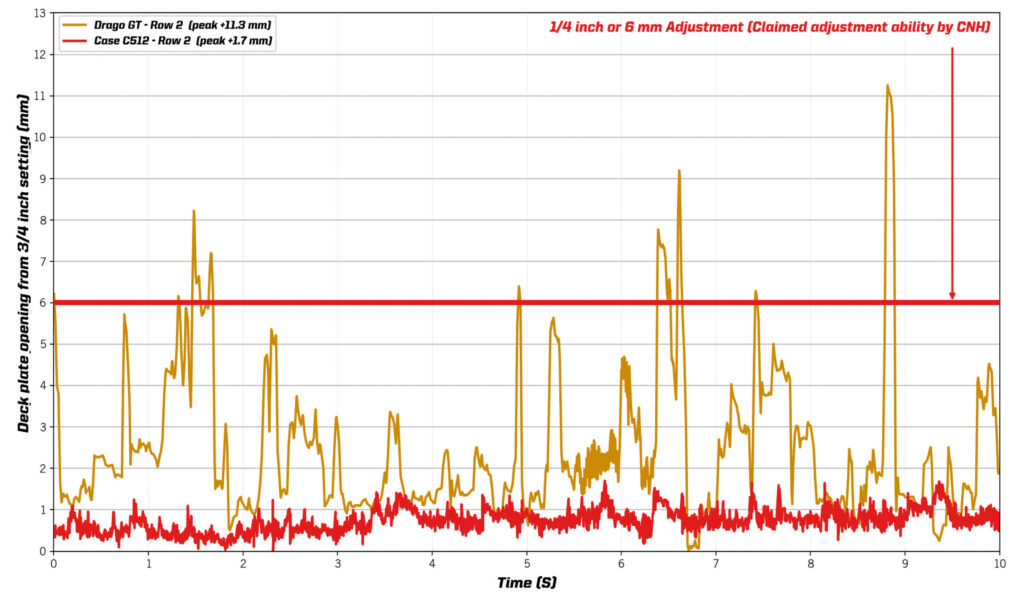
Case IH claims its hydraulically operated deck plates with their hard, rubber grommets can automatically adjust up to 6 mm or ¼ inch per row, but Drago harvest research has demonstrated that stalk widths can vary by more than ½” (12 mm) between rows. Those few millimeters could add up to thousands of bushels lost – over one season or many. Additionally, those lost kernels can increase the odds of unwanted volunteer corn in your crop rotation and the potential issues that follow.
See more about how Drago stacks up against Case.
In 2025 on-farm research, Drago found that Case plates required 173% more force than Drago plates to open 3 mm. Drago deck plates opened seven times wider and made eight times more adjustments than Case on every row. Drago plates independently and mechanically self-adjusted to accommodate stalks and keep them centered over the knife rollers. Research also found that trash dramatically increased as the Case deck plates narrowed, but it did not as Drago deck plates narrowed.
The 173% more force required to adjust Case plates – as identified in Drago research – may not be adequate for varying stalk quality conditions, unlike Drago’s spring tension. Fragile stalks may require a lighter tension to ensure they aren’t pushed over or broken off.
Drago Deck Plate Adjustments in 200+ Bu Corn: Drago GT versus Case C512
Mechanics minimize points of failure compared to Deere
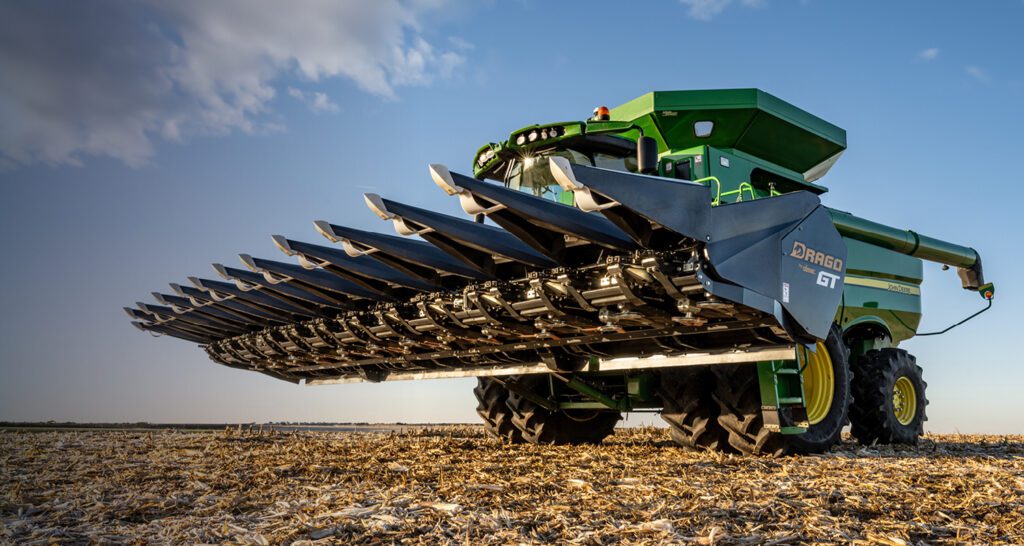
Deere has also recently introduced their own version of automatic deck plates. With a limited number of sensors on the new model-year 2027 Deere C Series, their automatic deck plates spend valuable time measuring stalk width ahead of the plates, then adjust equally for multiple rows based on those sparse measurements alone. With only one width setting for multiple rows, Deere deck plates can lead to even greater yield loss on larger corn heads.
“Our research shows that in higher-yielding corn, deck plate gaps can vary by a ¼ inch row to row 40% of the time, and sometimes by a ½ inch or more,” shares Dustin Bollig, farmer and vice president of sales and marketing for Dragotec USA. “If a system is only sampling stalk width on two rows across the entire corn head, how accurately can that really reflect what each individual row needs? With deck plate gaps and stalk widths varying so greatly, a Drago head is built to truly adjust to each stalk row by row in real-time.”
Every Drago plate automatically keeps up with the 100 or more stalks entering across the head every second of harvest through pure, mechanical engineering – no delayed electronics and no hydraulic adjustments that could leave room for error.
Drago also does not charge additional fees or subscriptions for its plates – or any other feature – to function. Time-tested, field-proven innovation for harvesting today’s hybrids comes standard.
See more about how Drago stacks up against Deere.
Preserving yield regardless of conditions
Another advantage competitor plates can’t claim comes through Drago’s QuadSuspension™. These “ear shocks” under each deck plate reduce ear bounce and butt shelling, thereby increasing harvestable yield capture. In variable conditions across U.S. corn operations, automatic self-adjusting deck plates and QuadSuspension™ help ensure your combine head is set up to succeed from the start.
Indiana corn grower Ryan Kohlhagen says:
“More kernels end up in the grain tank rather than on the ground by means of the deck plates because they are adjusting by themselves. And on our GT, they are also cushioning the ear from butt-shelling if it’s too dry. That’s been a great advantage compared to the brand we had in the past.”
Don’t risk another bushel to misadjusted deck plates
With competitive introductions of so-called automatic deck plates, others are acknowledging the potential yield loss caused by manually operated hydraulic plates – something Drago and Olimac, the world-class manufacturer of Drago corn heads, knew to be true all along.
To put the numbers in perspective, a 1,000-acre corn farmer who switched to Drago from the beginning could have captured 20,000 more bushels* over five years than one who never did, thanks to better deck plates alone.
According to Drago’s market research, most Drago owners purchased their head for yield capture, while mainline head owners purchased to match their combine brand. Research also indicated more than 90% of Drago owners report they are “very” to “extremely satisfied” with their corn head.
When every investment matters in a down market, don’t let brand loyalty limit your harvest technology. Choose the corn head made to instantly close gaps in every row while increasing your margins, preserving the yield and operation you work so hard to grow.
*Assuming 1/8” gap can lead to a one- to four-bushel yield loss/acre, according to Iowa State University research.