

The first corn head was introduced more than 70 years ago — how have they changed since then?
In 1954, combine manufacturers John Deere and International Harvester introduced new corn heads, and a European brand called Olimac also launched its “Integral Head” that could both pick and shell corn. This revolutionary year for corn harvest mechanization was just the beginning, and it’s worth looking at how far the evolution of the corn head has advanced in the decades since — especially with the introduction of the new Drago GT+ corn head.
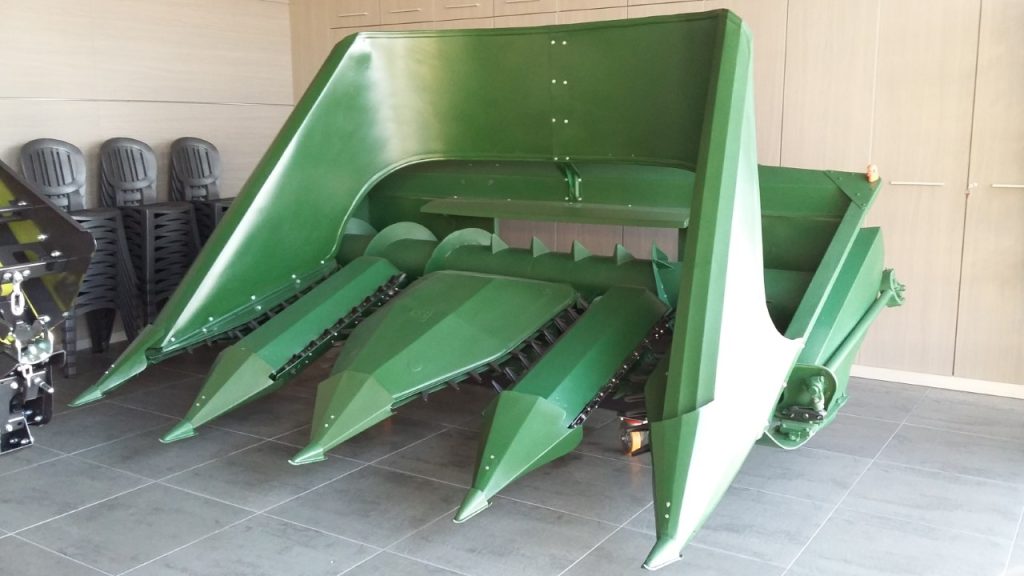
“The basic structure of the first corn head is very similar to all modern-day corn heads,” says Iowa farmer and Dragotec President, Denny Bollig. “They typically all have some type of stalk roller device, deck plates, a pair of gathering chains and a cross auger that moves corn into the feeder house.
“For four decades, we had corn pickers without deck plates – they just had long snapping rollers,” Bollig says. “Back then, corn typically was wet and kernels were so firmly attached to the cob that butt-shelling wasn’t a serious issue. With the advancement of hybrids that could dry down faster, the loss from butt-shelling became horrendous.”
“The introduction of deck plates – that were then bolted on – was driven by that harvest loss,” Bollig says.
Subtle Adjustments Make a Big Difference
As corn head technology evolved, Bollig notes that John Deere corn heads built in the 70s were a benchmark for other brands. “They were very reliable and simple, but 50 years later, the basic mechanics of their heads have changed little.”
He says in recent years, many corn head innovations that reduce yield loss have been introduced by Olimac.
“In 1995, thirteen years after Olimac came out with hydraulic deck plates, John Deere followed suit,” Bollig says. “And that was a big thing at the time.” Olimac had designed that adjustability because they saw a yield loss occurring that demanded some kind of change.
“It was a substantial improvement over bolted deck plates and highlights the importance of deck plates and the ability to limit yield loss.”
Bollig says that when Olimac introduced hydraulic deck plates in 1982, corn heads were still relatively small. “You could be a little more accurate on your adjustments because you could actually see both ends of the corn head. Today, with corn heads having three and four times as many row units as they had then, we know hydraulic plates are unable to compensate for the plant variability that allows kernels to slip through.
“Yield loss pushes change,” Bollig says.
For more than 25 years, Drago Automatic Self-Adjusting Deck Plates have led the way in harvestable yield capture.
“When we consider 60 percent of yield loss at harvest is at the corn head,” Bollig continues, “Olimac was challenged to come back with new and better ideas, which is why they introduced Automatic Self-Adjusting Deck Plates on each row in 1997. No other corn head brand offers that yield-saving feature.”
Other changes include the shape of the deck plate itself.
“Drago deck plates feature a rolled edge about a half-inch thick,” Bollig says. “The design allows the plant to be pulled down and strip off the ear while minimizing stripping off the leaves.
“If you have a thinner edge, it’s almost like a knife and the stalk is likely to kink or break off. We want to reduce the amount of plant material going into the combine so it can be more efficient.”
Today, with both John Deere and Case introducing their own versions of automatic deck plates, competitors are acknowledging what Olimac knew all along: continuous adjustments matter.
Gathering Chains
There are differences in combine manufacturers’ gathering chains, too. Bollig points out that Drago gathering chains are placed out front of the corn head where they can grab stalks – a feature that pays dividends in downed or leaning corn. “Other chains are simply designed to move ears after they’ve been removed from the stalk, but ours are designed to improve yield.
“Yet another design feature is that our chains actually angle apart as they move to the back of the row unit. This is so they can let go of stalks, limit breakage, and reduce plant material moving into the combine. Reducing material other than grain into the combine enables more efficient threshing, less wear, and less harvest loss out the back end,” Bollig adds.
Stalk Rollers
Bollig notes that brands offer different kinds of stalk rollers. “The job of a stalk roller is to pull the plant down fast enough that it separates the ear, but not so fast that it causes butt-shelling,” Bollig states. “Drago knife rollers are longer than most, so they have more time to process corn without having to run as fast as some other brands.
“Some brands give their stalk rollers more to do, including sizing up plant material along with pulling the plant down,” Bollig says. “But you need a lot of power to do that, and they have to run fast, which can result in added butt-shelling.
“Of course, with the GT, Olimac went to a whole new level by adding shock absorbers under the deck plates to absorb the energy of those ears hitting the deck plates,” he adds.
“Sizing stalks has the benefit of helping plants break down faster, as well as to open stalks where corn borers overwinter. Rather than risk additional butt-shelling, Olimac’s answer was to introduce stalk choppers to cut stalks instead,” says Bollig. “Our Drago GT and Drago GT+ models, in fact, feature a Twin Chop option with counter-rotating blades that deliver the best sizing option in the industry.”
Cross Auger
Yet another subtle but important evolution in corn head design involves the cross auger. Both the Drago GT and Drago GT+ feature an exceptionally large cross auger, aimed at improving crop flow to help keep the corn in the feeder house. The GT+ has improved crop flow with deeper flighting on the auger.
“All combine brands have a certain amount of back-feeding, but the large auger blocks the window of escape for an ear of corn that’s getting back-fed,” says Bollig.
Lower Profile
Bollig mentions that other subtle changes in corn head design include the profile of the corn head itself.
Drago corn heads run at a flatter angle than most other corn heads, allowing you to get lower to the ground which helps harvest plants with lower ear placement. “The flatter angle helps reduce loss from ear bounce, too,” Bollig adds.
“The lower profile is especially beneficial in down corn where it helps to get low and stay underneath plants, all the way down to our points, and helps lift ears to the auger easier with less damage from chains.”
Ultimate Goal
When it comes to corn head changes, it’s one thing to have apparent improvements such as Automatic Self-Adjusting Deck Plates or shocks under the plates, but subtle design shifts like gathering chains angling away, or knife rollers that process plants their entire length, are just as innovative, too.
In 1900, one person could shuck about 100 bushels of corn in a nine-hour day. Today’s combines can shuck and shell over 100 bushels in less than five minutes.
“As a farmer, you never know what harvest is really going to be,” Bollig says. “You hope your crop will be standing straight, but we know we’re at risk – right up to the day you pull the combine into the field – of having that corn blown over by wind. The ultimate goal is to get more yield while managing all the different conditions you might run into at harvest,” Bollig says.
“In a perfect world, a lot of these other corn heads might be perfectly fine. It’s just that we don’t farm in a perfect world.”
Discover the new features that add up in your overall ROI with the latest development in yield capture and harvest efficiency: the Drago GT+ corn head.